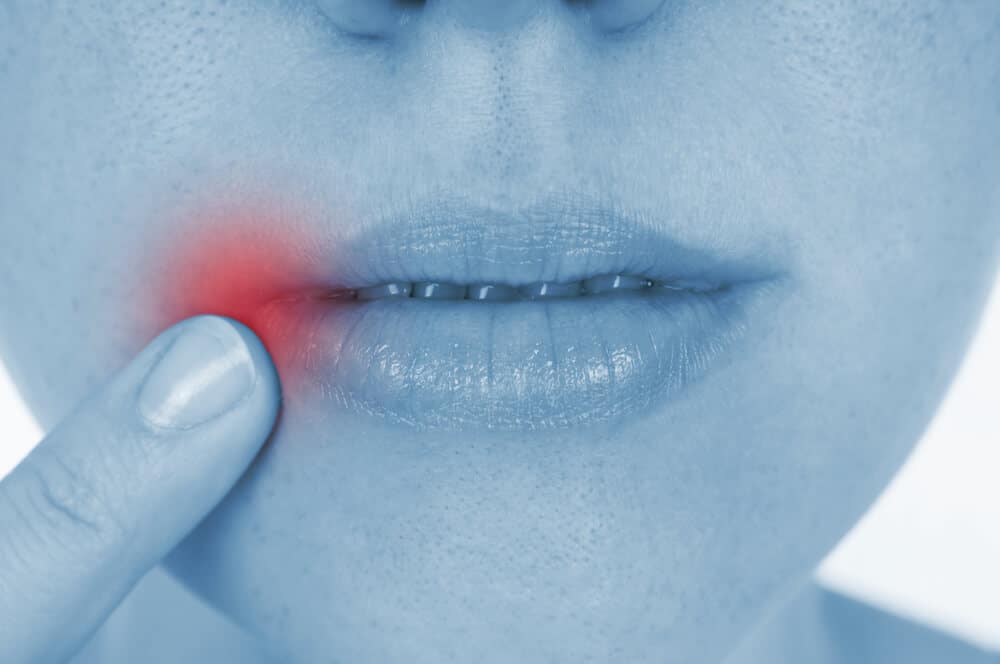
1. Itching

One of the first signs that you may be developing a cold sore is an itching sensation on or around the lips.
When Does the Itching Begin?
Itching usually starts around 12 to 24 hours before the visible signs of a cold sore develop.
Why Herpes Can Cause Itching
As a cold sore is forming, you may feel an itching sensation on or around your lips and mouth. Most people feel this as a result of the blister forming in its pre-visible stage.
Itchiness isn’t the only sensation you may experience in your lips, either…
2. Tingling and Burning

Before a cold sore is visible, you may also experience some tingling and/or burning sensations on or around your lips and mouth.
When Does the Tingling and Burning Begin?
Tingling and burning often occur within the 12 to 24-hour time frame before a cold sore is visible and can range in severity, however, they’re most often mild symptoms.
Why Herpes Can Cause Tingling and Burning
Like the itching sensation previously described, the tingling and burning sensation that can be felt is the result of a cold sore forming during its early stages.
The following sign of fever blisters? It’s perhaps the single most recognizable symptom of them all…
3. Blisters Around the Mouth and/or Lips

Blisters are the first visible sign of the HSV-1 virus that causes cold sores.
When Do Blisters Form?
Blisters can form within 6 to 48 hours after activation of the HSV-1 or, less commonly, the HSV-2 virus, in your system.
What Do the Blisters Look Like?
Blisters can form as a single spot or in patches known as clusters around the mouth and lips. Often times, blisters are sore, painful, swollen, and can appear red.
When Do the Blisters Go Away?
Additionally, in most cases, the blisters eventually break open, or burst, and leak a clear fluid before crusting over. Once a blister scabs over, it takes anywhere from several days to 2 weeks to heal and is usually yellow or white in appearance.
Blisters around the mouth and/or lips are unlikely to scar unless they are scratched or the scab is removed.
Why Herpes Can Cause Blisters Around the Mouth and/or Lips
Herpes can cause blisters to form when someone is infected with one of the herpes simplex viruses for the first time, or when one of the herpes simplex viruses already lying dormant in your system is activated. Once you have been infected, the virus remains inactive until triggered and can be spread through the clear fluid in the blisters.
The first time someone experiences an outbreak, the sores might not be exclusively found on the outside of the body…
4. Blisters in the Mouth and Gums

For most people, the first infection is the most severe. Because of this severity, blisters and clusters of blisters can form on the tongue, palate, and gums causing pain, swelling, and redness.
What Do the Blisters Look Like?
These blisters are similar in appearance to the blisters that can form around the mouth and can be incredibly irritable. These blisters can be quite painful and occur most often in cases involving children.
Why Herpes Can Cause Blisters
Unlike blisters around the mouth and lips, blisters in the mouth and gums most often occur only as a result of initial infection in children.
The following sign of oral herpes commonly affects people of any age…
5. Fever

During particularly severe outbreaks, some patients can develop a fever as a symptom of a cold sore.
What’s Considered a Fever?
For adults, a fever is defined as a body temperature of 101 to 104°F (38.4 to 40°C). Fevers higher than 104°F require emergency medical attention.
Why Herpes Can Cause Fever
You can develop a fever as a result of herpes when your body is working to fight off the infection. Body temperature rises in response to the outbreak, signaling the immune system to activate and making it more difficult for viruses and infections to survive and spread.
Only about 12% of people develop the following painful symptom…
6. Painful Gums

Luckily, only about 12% of people with HSV-1 or HSV-2 develop this symptom, with most cases occurring in children. Painful gums can occur as the result of erosion and blisters that form on the gum tissue on the roof of the mouth, as well as around the teeth.
When Does this Pain Occur?
This symptom can be extremely painful and usually only is present in patients who are experiencing their initial infection of herpes simplex virus.
Why Herpes Can Cause Painful Gums
Herpes causes painful gums as a result of the blisters, inflammation, ulcerative lesions, and erosion that can occur on the gum line around the teeth and on the roof of the mouth.
The following sign of oral herpes is also more likely to develop in children…
7. Sore Throat

Pharyngitis, or a sore throat, is the painful inflammation of the back of the throat, the back of the tongue, the roof of the mouth, and/or the tonsils. Sore throats are commonly associated with cold sores in adults and children. However, clusters in the throat itself are more likely to form in children’s mouths than in adults’.
Why Herpes Can Cause Sore Throat
You might experience a sore throat in tandem with a cold sore as a result of initial infection with the HSV-1 or HSV-2 viruses. Additionally, a sore throat can occur as a result of dehydration associated with pain from swallowing because of an outbreak on or in the mouth and throat.
Anyone noticing the following symptom should pay close attention, as it could signal the beginning of a rare complication associated with herpes…
8. Headache

Headaches are the most common form of pain and, as such, almost everyone has experienced one at least once in their life. It’s common to experience headaches in addition to your cold sore.
When are Headaches Severe?
However, if additional symptoms occur, like seizures, light sensitivity, fever, hallucinations, unconsciousness, unusual thoughts and/or behaviors; then, you should seek medical attention immediately.
Why Herpes Can Cause Headache
Herpes usually causes headaches as a general symptom. Having a cold sore, a headache, and additional symptoms can be seen as an indication of herpes meningoencephalitis. Herpes meningoencephalitis is a phrase that essentially means an infection or inflammation of the brain as a result of infection with HSV-1 or HSV-2. It is a serious condition that requires immediate medical attention.
As with some of the previously discussed symptoms of cold sores, studies show that children and newly infected adults are most likely to suffer from headaches and herpes meningoencephalitis.
The indicator of cold sores is much more common (and less serious)…
9. Muscle Aches

Muscle pain and aches are almost as common as headaches and can also occur as the result of a cold sore. Muscle pain can range in severity from mild to very painful depending on the severity of the case.
Why Herpes Can Cause Muscle Aches
Muscle aches and pains occur most commonly in cases concerning primary infection with the HSV-1 and HSV-2 viruses in children and adults. For some, this can last for between 4 and 5 days after the infection.
The final sign of mouth herpes on our list? It’s coming up next…
10. Swollen Lymph Nodes

Lymph glands, or lymph nodes, function as filters that aid your body in fighting off infection. Lymph nodes trap bacteria, infection, and viruses (like HSV-1 and HSV-2) in their cells to prevent them from contaminating the rest of your body. This built-in prevention technique can result in the glands becoming swollen, tender, and painful as a result.
Why Herpes Can Cause Swollen Lymph Nodes
Swollen lymph nodes in the genital area can manifest along with cold sores as a result of herpes simplex virus type 2. Conversely, swollen lymph nodes in the throat area can occur alongside cold sores as a result of herpes simplex virus type 1.
What About Prevention and Treatment?
Keep reading for more information about prevention and treatment of this condition…
How to Prevent Cold Sores

Unfortunately, there is no cure for the herpes simplex virus type 1 or type 2 at this point. However, there are steps that you can take to prevent and treat cold sores and their associated symptoms.
How Many People Have Herpes?
Almost half of all Americans already have herpes simplex virus type 1 and 11.9% have herpes simplex virus type 2. This is because both types of the herpes simplex viruses are highly contagious, even if no symptoms are present and/or the virus is inactive.
When are Cold Sores Most Contagious?
Cold sores are most contagious when they are visibly present and ruptured; they remain contagious until healed. (25)
Ways to Prevent Cold Sores
Despite this, there are ways to minimize the risk of reoccurring cold sores and lower your chance of infecting others. To avoid spreading the HSV-1 and HSV-2 viruses when you have a cold sore, it’s important to practice regular hand washing anytime you touch the affected area. Additionally, sharing drinks and food, oral sex, and kissing can all serve as transmission sources and should be avoided as well.
What About Treatment?
What are some of the primary treatment options for those with cold sores?…
Treatment for Cold Sores

Research shows that there is effective treatment available that can help to lessen the pain and discomfort associated with the various manifestations of HSV-1 and HSV-2, including cold sores.
Common Methods for Treating Cold Sores
Antiviral medicine can be used before known triggers cause an outbreak for those who are aware of their outbreak triggers. Treatment with over-the-counter anesthetics or antiviral creams also can help to lessen the pain and swelling associated with cold sores and clusters.
Reducing the Odds of Future Outbreaks
Regular treatment can also help to lessen the number of return cold sores in the future. Consider speaking with your primary health care provider for more information on cold sores if you experience frequent or severe outbreaks and symptoms.
Final Thoughts
Cold sore may not be aesthetically pleasing, but they are relatively harmless in and of themselves in most cases. For this reason, it’s important to practice safe preventative measures and seek regular treatment when you are suffering from a cold sore or cold sore-related symptoms.
So the next time you have a cold sore remember: you are not alone, and there is help available for your symptoms.